
Chapter Jump: 1
Book Summary 📜
The Second Epistle of John is a brief but potent personal letter written by the Apostle John (the Elder) near the end of the first century, likely from Ephesus around AD 85–95. Addressed to “the elect lady and her children” (widely understood as a local church and its members, or possibly a faithful Christian mother and her family), this short note emphasizes the inseparable connection between truth and love. John writes with pastoral warmth and apostolic urgency to encourage steadfastness in the face of deceptive teachers.
The heart of the letter is a clear call to walk in truth and love. John rejoices that the lady’s children are “walking in the truth” (2 John 1:4) and repeats the command he received from the beginning: “that we love one another” (v. 5). He defines this love not as sentiment but as obedience to God’s commandments. At the same time, he issues a strong warning against false teachers who do not confess “Jesus Christ coming in the flesh” (v. 7). Such deceivers are antichrists. John gives a practical and protective instruction: do not receive them into your house or give them any greeting, lest you share in their wicked works. This protects both the church’s purity and the family’s faith.
Though only thirteen verses long, 2 John is a powerful charge for families, coaches, and spiritual leaders to guard the truth while practicing biblical love. It reinforces the need for rightly ordered priorities: loving God and His truth first, then extending genuine love within the household of faith. For parents raising children in the faith and for those mentoring young believers (like athletes or students), this letter underscores the importance of teaching sound doctrine and protecting the next generation from error.
John closes with the hope of visiting soon and sending greetings from “the children of your elect sister.” This short epistle remains a concise manual for truth-centered hospitality, doctrinal vigilance, and family-level faithfulness in an age of confusion and compromise. It calls every believer to abide in the teaching of Christ so that we may have both the Father and the Son.
2 John Chapter 1
1 The elder unto the elect lady and her children, whom I love in the truth; and not I only, but also all they that have known the truth;
2 For the truth’s sake, which dwelleth in us, and shall be with us for ever.
3 Grace be with you, mercy, and peace, from God the Father, and from the Lord Jesus Christ, the Son of the Father, in truth and love.
4 I rejoiced greatly that I found of thy children walking in truth, as we have received a commandment from the Father.
5 And now I beseech thee, lady, not as though I wrote a new commandment unto thee, but that which we had from the beginning, that we love one another.
6 And this is love, that we walk after his commandments. This is the commandment, That, as ye have heard from the beginning, ye should walk in it.
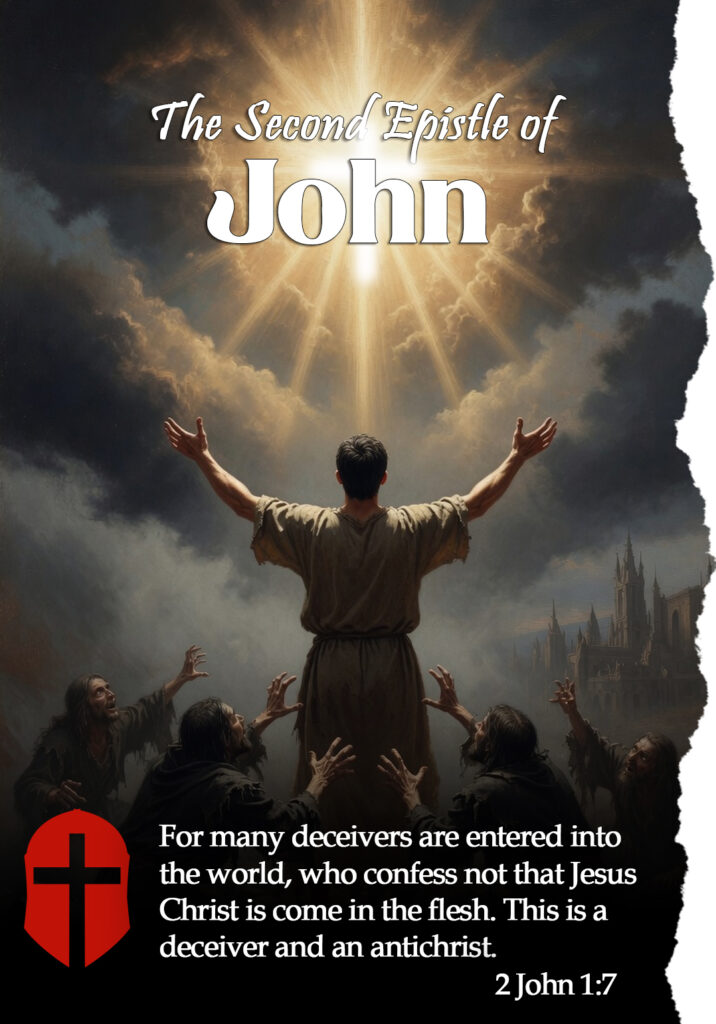
7 For many deceivers are entered into the world, who confess not that Jesus Christ is come in the flesh. This is a deceiver and an antichrist.
8 Look to yourselves, that we lose not those things which we have wrought, but that we receive a full reward.
9 Whosoever transgresseth, and abideth not in the doctrine of Christ, hath not God. He that abideth in the doctrine of Christ, he hath both the Father and the Son.
10 If there come any unto you, and bring not this doctrine, receive him not into your house, neither bid him God speed:
11 For he that biddeth him God speed is partaker of his evil deeds.
12 Having many things to write unto you, I would not write with paper and ink: but I trust to come unto you, and speak face to face, that our joy may be full.
13 The children of thy elect sister greet thee. Amen.
About the Author: John
The Second Epistle of John is traditionally attributed to John the Apostle, known as “the disciple whom Jesus loved.” He was the son of Zebedee, a Galilean fisherman, and became one of Jesus’ innermost circle of followers. John witnessed key events including the Transfiguration, the Crucifixion, and the Resurrection. Later in life, he served as a leading elder in the church at Ephesus. Writing near the end of his life (around 85–100 AD), the aged apostle penned this brief letter to warn against false teachers and to strengthen believers in walking in truth and love.
All Scripture is from the King James Version (KJV) of the Holy Bible. Chapter summaries © 2026 CiK Republic. Provided as a free study resource.