
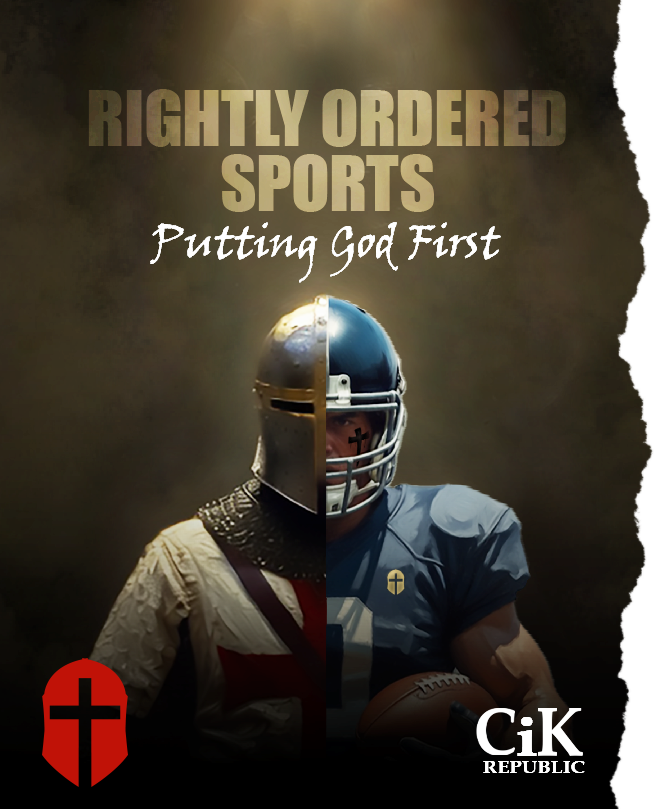
Rightly Ordered Athletes: Cultivating Virtue, Discipline, and Excellence in Body, Mind, and Spirit
A rightly ordered athlete brings every dimension of athletic life, training, competition, recovery, ambition, failure, and success, into alignment with God’s created order.
Sport is not the ultimate pursuit but a powerful arena for stewarding your body, sharpening character, building relationships, and glorifying God.
This is not about being a “Christian who happens to play sports,” but about being an athlete whose faith reorders every priority, decision, and motivation.
You train with intensity, compete with courage, and rest with peace because your identity is rooted in Christ, not in stats, rankings, or trophies.
The Rightly Ordered Athletes Handbook is deeply rooted in St. Augustine’s concept of rightly ordered love (ordo amoris), which teaches that true peace and flourishing come from loving God above all else, then loving others like yourself, and properly subordinating love of self and sport so that every athletic pursuit serves higher goods rather than becoming an idol.¹
Why This Matters
Modern sports culture often pushes performance at all costs, leading to burnout, injury, moral compromise, and emptiness.
A rightly ordered approach protects you from these traps while unlocking deeper joy, resilience, and lasting impact.
“Do you not know that in a race all the runners run, but only one gets the prize? Run in such a way as to get the prize. Everyone who competes in the games goes into strict training. They do it to get a crown that will not last; but we do it to get a crown that will last forever.” (1 Corinthians 9:24-25)
Reflection Questions
- What currently has the highest place in my athletic life?
- Am I willing to submit my sport fully to God’s order?
Ordering Your Loves
Rightly ordered athletics flows from rightly ordered loves. As Augustine taught, sin is disorder in our loves. The rightly ordered athlete loves:
- God above all — The greatest commandment (Matthew 22:37-38). He is the source of your talent, breath, and opportunity.
- Self – Proper self-love as foundation (“as yourself”) and stewardship of your body/soul (1 Cor 6:19-20)
- Neighbor — Second commandment love “as yourself”. Teammates, opponents, coaches, and family come before self-glory.
- Sport — A good gift to use for God’s glory, but not to idolize. Your body, ambition, and success are important but subordinate.
The Rightly Ordered Athlete’s Creed
I am not defined by my performance. I am a child of God, a steward of my gifts, and a competitor for His glory. I will train with discipline, compete with integrity, rest with gratitude, encourage others, and hold loosely to results.
Practical Application
- Begin every training session with a short prayer of surrender: “Lord, I present my body to You as a living sacrifice. Help me train with all my heart, for Your glory and not my own.” (Based on Romans 12:1 KJV)
- When tempted to cut corners or trash-talk, ask: “Is this loving God and neighbor?”
- Regularly evaluate: Does sport enhance my walk with God and relationships, or is it pulling me away?
Character and Virtue
Character is the bedrock of sustainable athletic success.
Talent may open doors, but character keeps them open and determines how you walk through them.
Cardinal Virtues for Athletes
- Prudence: Making wise choices in training volume, nutrition, recovery, and risk management.
- Justice: Playing by the rules, showing respect to officials and opponents, and giving credit where due.
- Fortitude: Pushing through soreness, adversity, and repeated failure without quitting.
- Temperance: Exercising self-control over appetite, ego, screen time, and schedule.
Additional Athletic Virtues
- Humility: Recognizing that every talent is a gift. Celebrate teammates publicly.
- Diligence: Doing the unseen work (mobility, film study, extra reps).
- Gratitude: Maintaining thankfulness even in losing seasons.
- Courage: Speaking up against team sin, admitting when you’re wrong, or trying a new position.
Growth Plan Identify one virtue to focus on each month. Journal how it shows up (or fails to show up) in training and competition.
Body as Temple
“Do you not know that your bodies are temples of the Holy Spirit, who is in you, whom you have received from God? You are not your own; you were bought at a price. Therefore honor God with your bodies.” (1 Corinthians 6:19-20)
Core Training Pillars
- Consistency: Show up daily even when motivation is low.
- Progressive Overload: Gradually increase demands while respecting limits.
- Specificity: Train movements and energy systems that directly transfer to your sport.
- Periodization: Build, peak, and recover in intentional cycles.
Nutrition & Fueling
Eat to fuel stewardship, not to chase aesthetics. Prioritize protein for muscle repair, complex carbs for energy, healthy fats, and micronutrients. Hydrate religiously.
Treat cheat meals as rare celebrations, not daily habits.
Recovery Disciplines
- Sleep 7–9 hours nightly.
- Incorporate mobility, foam rolling, and active recovery.
- Listen to your body — distinguish between normal discomfort and warning signs of injury.
Injury Management
View injuries as temporary assignments in patience and dependence on God.
Follow medical advice, use the time for mental and spiritual growth, and return stronger and wiser.
Renewing the Mind
Athletics is won or lost between the ears.
A rightly ordered mind is renewed by truth rather than ruled by emotion or circumstance.
Key Mental Practices
- Growth Mindset: See every failure as feedback and every success as grace enabled.
- Scripture Based Self-Talk: Replace “I’m not good enough” with “I can do all things through Christ who strengthens me” (Philippians 4:13).
- Visualization: Daily rehearse successful execution, calm under pressure, and gracious responses.
- Present-Moment Focus: Use cues (breath, one word, physical anchor) to stay locked in during competition.
Handling Pressure & Anxiety
Develop a pre-competition routine:
- Prayer of surrender: Pray this before taking the field or court.
“Heavenly Father, As I step into this competition, I surrender this game fully to You. I offer my body, my effort, my skill, and my attitude as a living sacrifice. Remove any selfish ambition or fear from my heart. Help me to compete with all my strength, integrity, and courage — not for my own glory, but for Yours alone. May my actions honor You, whether the outcome is victory or defeat. I trust You with the results. In the name of Jesus Christ, Amen.” (Based on Colossians 3:23 KJV)
2. Deep breathing & Visualization.
3. Power verses.
4. Process-focused goals (effort, execution, attitude).
Post-competition:
Review facts, not feelings. Extract lessons, then release the outcome.
“In every thing give thanks: for this is the will of God in Christ Jesus concerning you.” (1 Thessalonians 5:18)
Competing for an Eternal Prize
Sport becomes worship when offered to God.
Daily Integration
- Start the day with Scripture and prayer before touching your phone or gear.
- Use training time for prayer (e.g., pray for & with teammates during warm-up).
- Memorize verses for specific needs: endurance (Hebrews 12:1), peace (Philippians 4:6-7), courage (Joshua 1:9).
Witness and Platform
Compete so that your attitude, work ethic, and integrity cause others to ask about the hope within you. Encourage opponents.
Point glory away from yourself.
Eternal Perspective
Championships end. Records fall. The character you build and the people you impact endure. Run for the “unfading crown of glory.”
Team, Coach, and Community
No athlete is an island. Rightly ordered athletics builds others up.
Teammates Foster unity. Confront sin privately and lovingly. Rejoice with those who rejoice. Carry the burdens of the discouraged.
Coaches Submit with respect (Ephesians 6:5-8). Communicate needs clearly and humbly. Honor their authority as unto the Lord.
Family & Community Protect time for family dinners and important events. Use your platform to serve — speak at youth groups, mentor younger athletes, or volunteer.
Accountability Partners Meet regularly (weekly or bi-weekly) with 1–2 trusted believers to discuss:
- Character struggles
- Balance
- Prayer needs
Excellence with Humility
Compete to win with all your heart — but hold victory with open hands.
Performance Principles
- Prepare with excellence.
- Execute with focus and courage.
- Adapt when plans fail.
- Finish strong regardless of position on the scoreboard.
Grace-Filled Competition
Respect opponents as fellow image-bearers. Shake hands. Refuse gamesmanship. Win without arrogance; lose without despair.
Post Competition Routine
- Immediate gratitude prayer. “Heavenly Father, Thank You for the strength to compete today. I am grateful for the opportunity to use the body and abilities You have given me. Whether in victory or defeat, I thank You for Your sustaining grace, for my teammates, opponents, and coaches. Help me learn from this contest, grow in humility and wisdom, and give You all the glory. In the name of Jesus Christ, Amen.” (Rooted in 1 Thessalonians 5:18 KJV)
- Objective debrief (technical, tactical, mental, spiritual).
- Celebration or mourning in healthy ways.
- Move forward — tomorrow is a new training day.
Pitfalls and Restoration
Major Pitfalls
- Making sport your identity (idolatry).
- Overtraining and neglecting rest.
- Comparison, envy, and bitterness.
- Cutting ethical corners for an edge.
- Neglecting faith and relationships during intense seasons.
Restoration Process
- Confession — Be honest with God and a trusted person.
- Repentance — Turn away from the wrong pattern.
- Grace — Receive forgiveness and new mercies.
- Realignment — Reorder priorities and habits.
- Return — Step back into training with humility and renewed purpose.
Setbacks are often the best teachers.
Daily Practices and Habits
Morning Routine
- Scripture reading and prayer (10–20 minutes).
- Gratitude for body and opportunity.
- Set one focus for today’s training.
During Training
- Intentional warm-up and cool-down.
- Full effort with presence.
- Short prayers between sets or drills.
Evening Routine
- Review the day (wins, struggles, lessons).
- Plan tomorrow.
- Wind down without screens.
- Evening prayer.
Weekly
- One full rest/Sabbath day.
- Accountability meeting.
- Acts of service or encouragement to others.
Seasonal
- Pre-season: Foundation building and goal setting.
- In-season: Maintenance and peak performance.
- Off-season: Recovery, skill development, and spiritual refreshment.
Resources and Accountability
Essential Reading
- The Bible (focus on Proverbs, Ecclesiastes, 1 & 2 Corinthians, Hebrews 12).
- Discipline Equals Freedom – Jocko Willink (secular discipline).
- The Inner Game of Tennis – Timothy Gallwey (mental mastery).
- Faith-based: Biographies of Eric Liddell, David Green, or modern Christian athletes.
Tracking Tools
Maintain a simple journal or app with three columns:
- Physical: Workouts, nutrition, recovery metrics.
- Mental: Key mindset shifts or struggles.
- Spiritual: Verses, prayers, growth areas.
Final Charge
Run the race marked out for you with perseverance, fixing your eyes on Jesus, the author and perfecter of your faith (Hebrews 12:1-2). Train hard. Love deeply. Keep all things rightly ordered.
This handbook is meant to be lived, not just read. Review it monthly. Discuss sections with your team or accountability partners. Adapt it to your sport while keeping the core principles intact.
Stay faithful. Stay disciplined. Stay rightly ordered.
Go and compete for the glory of God.
¹ St. Augustine, The City of God, XV.22. (See also On Christian Doctrine, I.27-28).